23.10.2026
Expanding Scientific Collaboration with Beijing Institute of Technology
Our research group is strengthening its scientific cooperation with Beijing Institute of Technology (BIT) in the fields of catalysis and CO₂ technologies.
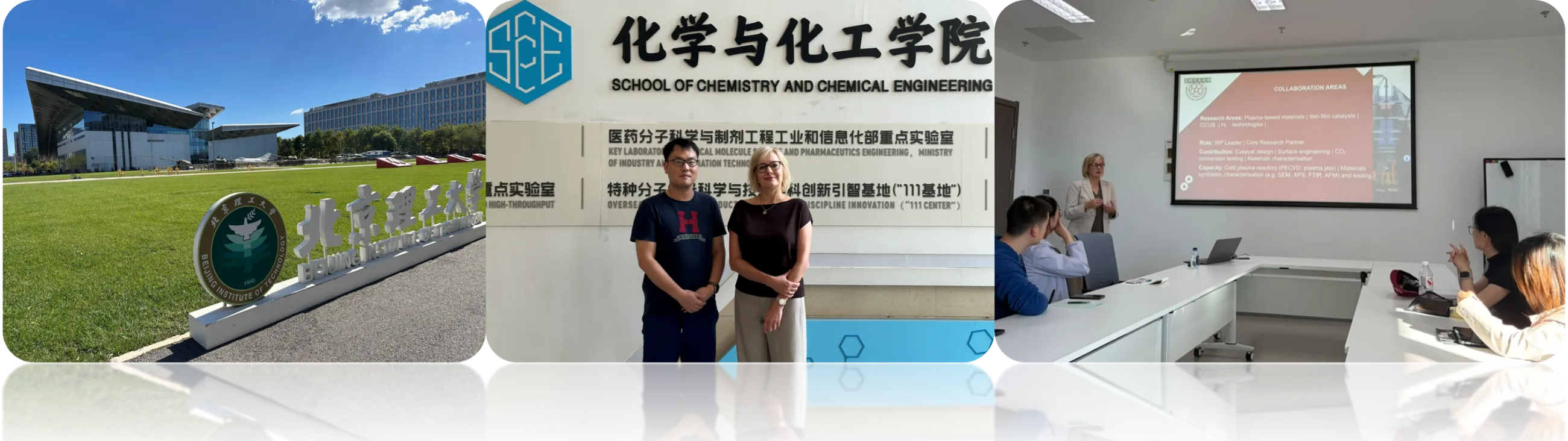
From 10-17 October, Prof. Hanna Kierzkowska-Pawlak visited Beijing Institute of Technology (BIT) at the invitation of prof. Helei Liu from the School of Chemistry and Chemical Engineering.
The visit aimed to discuss opportunities for further research collaboration between our group and BIT in the area of CO₂ capture and conversion. During a series of meetings, both sides exchanged ideas on future research directions and the preparation of joint research projects. The program also included a visit to the Beijing Laboratory for System Engineering of Carbon Neutrality, where the research infrastructure and ongoing activities were presented.
An important part of the visit was a presentation introducing the scientific profile of Lodz University of Technology and the Faculty of Process and Environmental Engineering. Prof. Kierzkowska-Pawlak also delivered a lecture entitled “Nanocomposite Thin-Film Catalysts Deposited by Cold Plasma on Structured Packings: From Material Design to Applications”, presenting the research activities of the Division of Molecular Engineering. The lecture focused on plasma-deposited nanocomposite thin-film catalysts and their potential applications, among others, in CO₂ conversion processes.
The stay at BIT also provided an opportunity to explore the university’s Liangxiang campus, located in the southern part of Beijing. The campus impresses with its combination of modern academic facilities, green landscapes, ponds, and elements of traditional Chinese architecture.
👉 More photos of the campus: https://lnkd.in/p/gU_GavyD
26.11.2025

Poland–China collaboration: Plasma-prepared catalysts for CCUS technologies
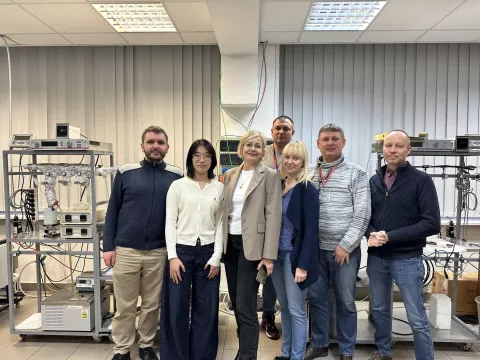
From November 12 to 25, 2025, we hosted Liju Bai from the School of Chemistry and Chemical Engineering, Beijing Institute of Technology (China). The visit was funded under the PROM project (FERS.01.05-IP.08-0218/23).
Liju Bai is pursuing a Ph.D. entitled “Design and Process Research for High-Performance Carbon Capture Materials” under the supervision of Prof. Helei Liu. Research in this area, conducted at the Department of Molecular Engineering under the guidance of Prof. Hanna Kierzkowska-Pawlak, focuses on designing innovative thin-film catalysts for CO₂ capture and conversion. During the internship, under the supervision of Dr. Ryszard Kapica, Liju Bai fabricated nanostructured catalysts using the PECVD method, which will be applied to intensify CO₂ capture processes. The efficiency of these catalysts and their impact on the performance of CO₂ removal processes will be tested in laboratory-scale CO₂ capture installations in China.
13.03.2025

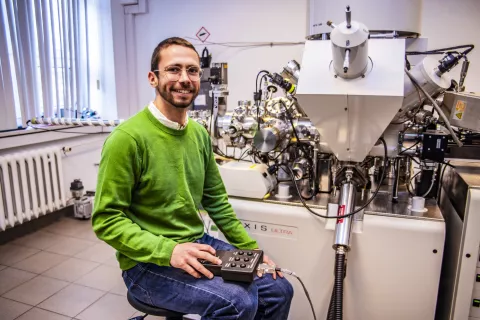
Gabriel Marques, a second-year PhD student in Physics Engineering at the University of Aveiro, is visiting the Division of Molecular Engineering at Lodz University of Technology as part of the PROM program.
Gabriel Marques, a second-year PhD student in Physics Engineering from the University of Aveiro is spending three weeks (24.02-15.03) at the Division of Molecular Engineering at Lodz University of Technology as part of the PROM program.
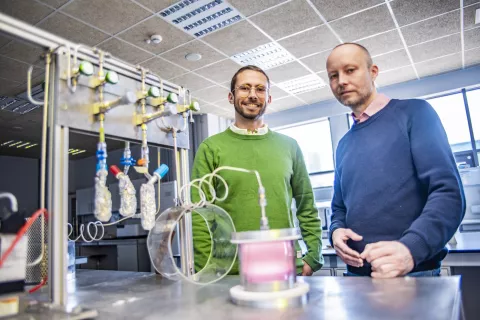
Gabriel's research focuses on the functionalization of silica nanoparticles with organic dyes and their optical characterization. His objective is to optimize the functionalization process to achieve controllable optical properties, which can be applied in sensors for leak detection. During his stay, under the supervision of Dr. Jacek Balcerzak, he is utilizing X-ray Photoelectron Spectroscopy (XPS) to gain crucial insights into the surface chemical structure of nanoparticles and to correlate these findings with their optical properties.
Image
| Image
|
Author: Marcin Szmidt
11.09.2024
Our team proposes a novel approach to the “alchemy” of catalysts
What's the deal with synergy? The role of heterojunctions in nanohybrid catalysts
Solid catalysts, often nanoscale materials, are at the heart of many technologies. In the recent Perspective „Classical Concept of Semiconductor Heterojunctions in the Approach to Nanohybrid Catalysts” we explored the secrets of nanohybrid catalysts— nanocatalysts composed of two different materials with distinct electronic structures. We identified key interactions that influence the reactivity of such multicomponent nanocatalysts, often described as "synergy." Our findings show that the formation of heterojunctions—regions filled with electric charges—between these materials can span the entire volume of the interacting components, significantly affecting their catalytic properties. This charge effect plays a crucial role in governing catalytic activity. By understanding the charge flow and interactions between different materials, we can take a rational approach to designing novel, more effective catalysts. The new finding is reported in the journal ACS Applied Materials & Interfaces and was featured on the cover. Although still in its early stages, this concept could have a profound impact on developing more effective nanohybrid catalysts tailored to specific needs.
What's more, we proposed a highly promising and proven method for fabricating nanohybrid catalysts: cold plasma deposition. We demonstrated how a cold plasma technique can be used to design and control both the molecular structure and nanostructure of nanohybrids with heterojunctions.
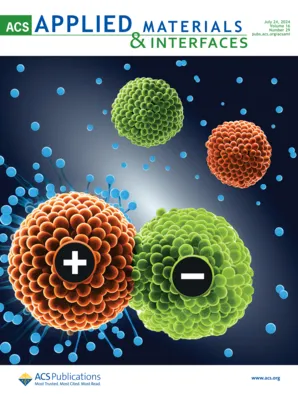
About the Cover: The formation of a heterojunction between nanoparticles of two different semiconductors, according to the classical concept, induces space charges within their volume. This can drastically improve the catalytic activity of such nanohybrids in thermocatalytic processes compared to the isolated nanoparticles.